

Tradition in Installments: Rabbinic Periodicals and the Making of an Orthodox Public Sphere, 1850–1940
|
Max Weinreich Fellowship Lecture in East European Jewish Studies
The Professor Bernard Choseed Memorial Fellowship and the Natalie and Mendel Racolin Memorial Fellowship Admission: Free |
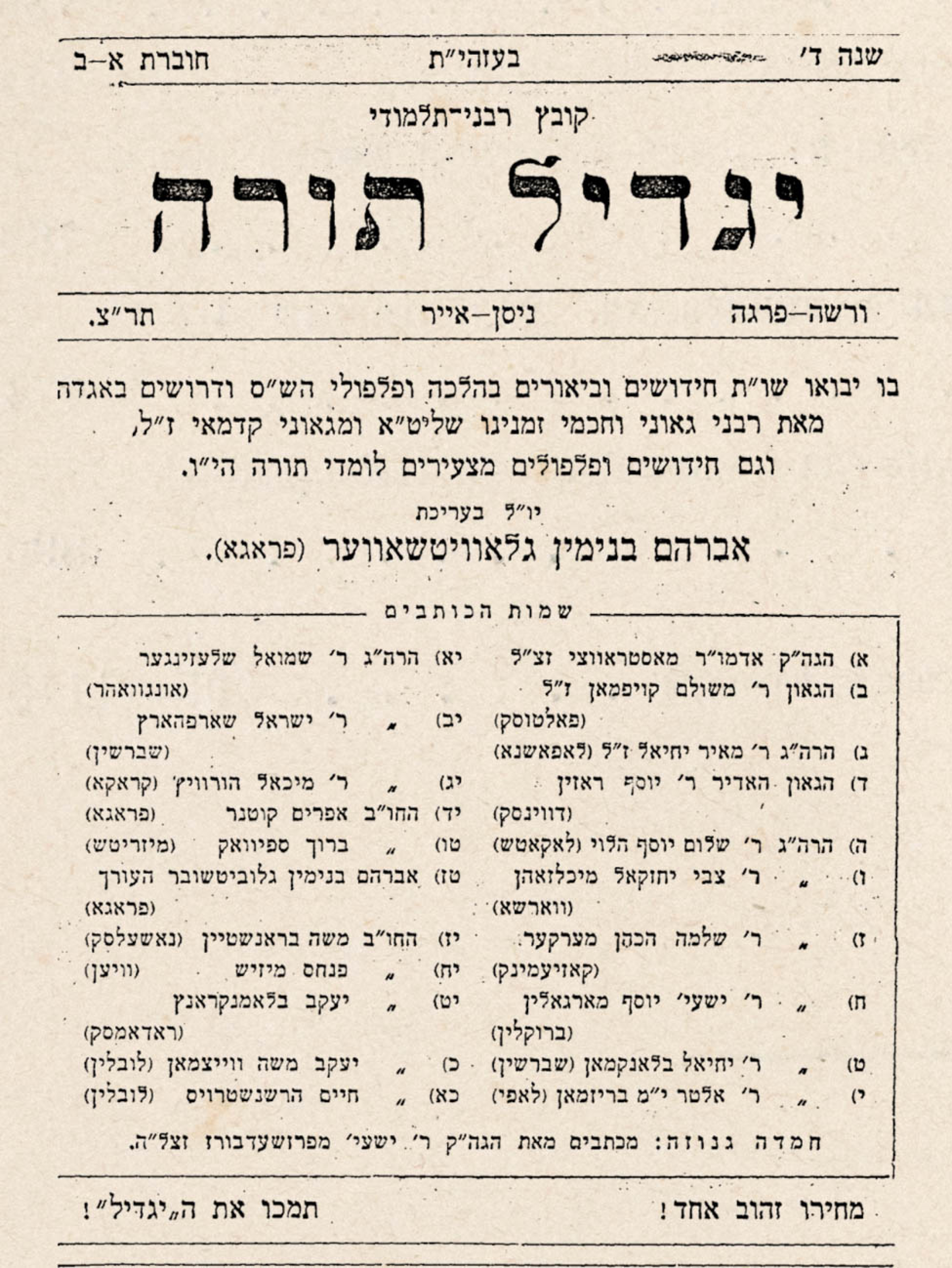
Between 1850 and 1940, a remarkable transformation occurred in the world of traditional Jewish learning: the emergence of a vibrant "periodical culture." This period witnessed the publication of dozens of distinct titles of "professional" rabbinic journals that reshaped Orthodox intellectual circles. Neither newspapers nor popular magazines, these were specialized scholarly periodicals devoted to Talmudic debate and halakhic reasoning—published in installments and read by scholars from Odessa to Chicago. However, the significance of this medium extends far beyond narrow legal discussions; it both reflected and catalyzed profound shifts within the social and religious landscapes of Orthodox Judaism, playing a pivotal role in forging a cohesive identity within an increasingly interconnected world.
Despite its impact, this phenomenon has remained almost entirely unstudied, falling between the cracks of historians focused on popular press and traditional scholars focused on legal content rather than media form. This lecture introduces a major research project that draws on YIVO’s unparalleled holdings to recover these journals as a historical phenomenon – one that transformed how rabbinic scholars argued, published, and understood themselves as a community. By adopting modern attributes and serial formats, these publications transformed private correspondence into a public, interactive, and transnational rabbinic public sphere, generating a new type of intellectual "buzz."
In this lecture, Elad Schlesinger will discuss how these journals served as a stage for intense halakhic and ideological polemics, simultaneously challenging and reinforcing traditional structures of authority; examine how they provided a unique hybrid space where tradition and innovation coexisted without rigid boundaries; and show how they fostered global connectivity and a sense of scholarly universality. Ultimately, these modern journals did not merely document Orthodox life; they actively shaped it.
About the Speaker
Elad Schlesinger studies Jewish and European history, rabbinic culture, and Jewish law. His work examines the sociology of knowledge production, the evolution of scholarly practices, and the intersection of law and print culture from the late Middle Ages to the modern era. His current research focuses on rabbinic periodicals as a phenomenon of media and intellectual history. He received his PhD from Ben-Gurion University of the Negev and is currently a postdoctoral visiting scholar at the Skirball Department of Hebrew and Judaic Studies at New York University. Prior to that, he was the Gruss Scholar-in-Residence at NYU Law School. He is the 2025-2026 recipient of the The Professor Bernard Choseed Memorial Fellowship and the Natalie and Mendel Racolin Memorial Fellowship in East European Jewish Studies.